Learning to dock a boat solo is not really a “steering” problem. It is a workload problem.
To dock a boat solo, you have to control speed, read wind and current, choose a landing point, handle lines, protect the hull, and still keep an escape route open. The way to make that manageable is to stop trying to do everything at once.
For a small powerboat, the most useful solo-docking habit is to build the entire approach around one control line—usually a midship spring line—then use the engine, wind, current, and fenders to hold the boat while you finish tying up.
This guide focuses on the kind of boat many coastal anglers actually run: a single-outboard or sterndrive center console, bay boat, skiff, or similar recreational powerboat without joystick docking. Inboards, twins, pods, and thrusters behave differently, so the exact maneuver should always be practiced on your own boat in calm, open conditions first.
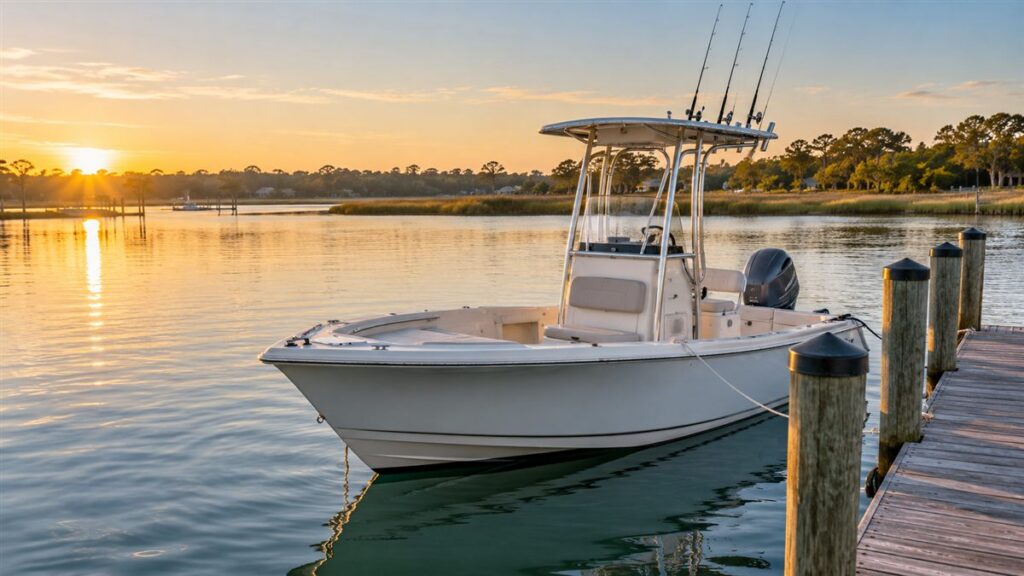
How to dock a boat solo with one control line
Prepare everything early, approach at the lowest speed that still gives you control, secure one useful line before leaving the helm, and abort before a small mistake becomes a big one.
That sounds simple, but each part matters. Most ugly dockings start before the boat reaches the dock: the fenders are still in a locker, the wrong line is in somebody’s hand, the operator has not checked the current, and there is no plan for what happens if the first attempt is bad. A clear plan matters whenever you dock a boat solo.
What to have ready before you approach the dock
You do not need a pile of specialized docking gear. You need a few basic pieces staged where you can reach them before the boat enters tight quarters:
- 3–4 properly sized nylon dock lines: enough to rig a midship control line plus bow, stern, or spring lines as the dock requires.
- 2–3 correctly sized fenders: already hung on the docking side and positioned for the actual contact points.
- A reachable boat hook: useful for grabbing a line or cleat without leaning over the gunwale.
- A proper midship cleat or control-line setup: use hardware designed to take docking loads, not a grab rail, rod holder, or windshield frame.
Before you enter the marina: set the boat up so you never have to rush
- Pick the docking side before the final approach. Move fenders and lines while you still have open water around you.
- Hang the fenders where contact will actually happen. One near the widest part of the hull and another near the stern quarter is a useful starting point. Add a third if the dock is rough, the boat is larger, or pilings create multiple contact points.
- Rig a midship control line. If your boat has a proper midship cleat, attach a nylon line there and lead the free end back where you can reach it from the helm or cockpit. Keep the line outside rails, rod holders, antennas, and anything else it can snag.
- Stage the bow and stern lines. They should already be attached to the boat with the working ends reachable from the cockpit. Do not leave loose line in the water where it can reach the prop.
- Put the boat hook where you can grab it without opening a compartment. A boat hook is for reaching a line or cleat and for a gentle push-off—not for stopping a moving boat.
- Identify the abort route. Before you commit, know where you are going if the angle, speed, wind, or traffic is wrong. Going around is normal seamanship, not a failed docking.
First, learn what the wind and current are doing to your boat
Before you dock a boat solo, stop well clear of the dock, shift to neutral, and watch the boat drift for a few moments.
Wind acts mostly on the boat above the waterline. Current acts on the hull and running gear below it. A T-top, windshield, hardtop, or high bow can make a relatively small boat move sideways much faster than expected, while tidal current may be pushing in an entirely different direction.
The important question is not “Which way is the wind blowing?” It is “Where will this boat go when I take power away?”
The midship spring-line method for docking solo
If you want to dock a boat solo, make the spring-line maneuver your first single-handed docking technique.
The problem with grabbing the bow line first is that the stern can swing away. Grab only the stern line and the bow can wander. A line near the middle of the boat gives you much more control over the whole hull and keeps the line close to the helm.
For an alongside landing on a small outboard or sterndrive boat, one useful setup is an after spring: the line starts at the boat’s midship cleat and leads aft to a cleat on the dock. Once it is secure, gentle forward thrust can work against the line instead of driving the boat forward.
- Approach slowly, with the fenders already down and the spring line ready.
- Bring the boat nearly parallel to the dock and position the midship cleat near a dock cleat that is slightly aft of it.
- Shift to neutral before reaching or stepping. Never jump for the dock.
- Get the spring-line loop over the dock cleat or make the line fast while keeping the controls within immediate reach whenever possible.
- If the boat wants to blow away from the dock, tension the spring gently with idle-forward power. On many outboard and sterndrive boats, turning the wheel away from the dock while the spring prevents forward motion will help press the boat against its fenders.
- Once the boat is stable, secure the stern and bow lines, then add or adjust the permanent spring lines for the final tie-up.
- Use only idle or very small throttle inputs. If the line, cleat, angle, or boat response is not behaving exactly as expected, go back to neutral and reset.
Learning to dock a boat solo is not something to try for the first time between two expensive boats. Boating Magazine teaches the same basic spring-line concept and specifically recommends practicing it at an empty dock in calm conditions until you know how your own hull reacts.
Important: the exact spring-line geometry changes the way the boat pivots. Do not blindly copy the maneuver with an inboard, an unusual cleat layout, or a line attached to a rail or other hardware that was not designed for docking loads.
Docking in wind and current: change the approach, not the goal
Wind pushing you toward the dock
When you dock a boat solo with wind pushing you in, get parallel a few feet off the dock, reduce momentum, shift to neutral, and let the wind finish the last part of the move.
Do not keep adding throttle because the boat is not touching the dock yet. You are already moving sideways. Let the fenders do their job.
Wind blowing you away from the dock
To dock a boat solo with wind pushing you away, let the midship spring earn its keep. Use enough angle and momentum to reach the dock without arriving hard, get the control line on first, then use the line and gentle engine thrust to hold the boat.
If you cannot get a secure line without leaning, jumping, or abandoning the helm while the boat is still moving, abort and make another approach.
Current running along the dock
When possible, point the bow into the current. Then use just enough power to nearly match the current so the boat is barely moving relative to the dock.
When you dock a boat solo in current, a small steering change can move the boat sideways without building much fore-and-aft speed. This is more controlled than letting the current push the transom from behind.
Wind or current pushing from behind
A following force keeps adding speed even when you pull the throttle back. If there is room, set up the approach so you are working into the stronger force instead. If you cannot, use a shallower approach, go to neutral early, and be ready to use reverse to arrest momentum.
Use neutral more than you think
Beginners who dock a boat solo often stay in forward gear too long because constant thrust feels necessary for steering. That creates the exact problem they are trying to solve: too much momentum.
At docking speed, think in short control inputs:
- Forward: create a little steerage or move the boat a few feet.
- Neutral: stop adding energy and let the boat coast.
- Reverse: arrest forward motion or reposition the stern when your propulsion system allows it.
On an outboard or sterndrive, turn the wheel before applying a brief burst of power. The engine or drive directs thrust from the stern, so a short, deliberate input usually works better than turning the wheel while simultaneously adding a lot of throttle.
The goal is not “slow throttle.” The goal is low boat speed. Those are not always the same thing when wind or current is involved.
What to do when the approach is going bad
Experienced operators who dock a boat solo often look boring because they never complete a bad approach.
Abort early if any of these are true:
- You are carrying more speed than you want at contact.
- Your bow or stern has drifted far enough that fixing it will require a large throttle input.
- The first line is tangled, under a seat, or in the water.
- A passenger or dockhand is about to use a hand or foot as a fender.
- Another boat enters the fairway or takes away your escape route.
- You cannot reach the dock without jumping or leaning outside the boat.
Reverse away while you still have room, reorganize, and come back. Making a second clean approach is one of the safest habits when you dock a boat solo.
Once you are alongside, every line should have a job
When you dock a boat solo, remember that dock lines are not multiple ropes doing the same job. Each line controls a different movement.
| Line | Main job |
|---|---|
| Bow line | Limits the bow’s movement away from the dock and helps control fore-and-aft position. |
| Stern line | Controls the stern and helps keep the aft end from swinging away. |
| After spring | Leads aft from the boat and prevents the boat from moving forward. |
| Forward spring | Leads forward from the boat and prevents the boat from moving aft. |
For a quick fuel stop, a well-placed bow line, stern line, and spring may be enough. For a longer stay, use proper opposing spring lines so wakes, wind, and current cannot work the boat back and forth along the dock.
At a fixed dock in tidal water, avoid tying the boat down with very short, tight breast lines. The water level can move several feet while the dock does not. Longer diagonal lines give the boat more room to rise and fall without hanging from its cleats or becoming dangerously slack.
Fender placement matters more than fender count
When you dock a boat solo, two modest fenders at the actual contact points can protect more than two giant fenders in the wrong places.
Before the final approach, look at the dock itself. Is the boat going to touch a floating dock edge, a vertical piling, a concrete wall, or the corner of a finger pier? Put the fenders between that structure and the part of the hull most likely to contact it.
If pilings are widely spaced, keep one fender that can be repositioned quickly. If the dock is rough or the water is lumpy, add more protection instead of hanging every fender at the same height out of habit.
Gear that actually helps when docking alone
The gear should support the technique, not replace it. Three things earn permanent space on a small boat:
- Usable nylon dock lines. Nylon’s stretch helps absorb shock, and a factory-spliced eye makes quick rigging easier. A Seachoice 1/2-inch x 20-foot double-braid nylon line is one example for boats and dock layouts where that diameter and length are appropriate. Carry more length than your home slip requires because transient docks vary.
- Fenders sized to the boat. For roughly 20- to 25-foot boats, Taylor Made’s manufacturer guidance places its Big B 6 x 15-inch fender in the right general range. Size the fender to the boat and docking environment rather than buying the smallest one that fits in a locker.
- A reachable boat hook. A 5–12-foot telescoping boat hook can retrieve a line, reach a cleat, or make a gentle push-off without putting your torso over the gunwale. It is not a substitute for engine control and should not be used as a lever against a moving boat.
For transient docking, bow and stern lines around two-thirds of the boat’s length are a common baseline, while spring lines should be about boat length or longer. Those are starting points, not laws. A 22-foot center console at a floating fuel dock has different needs than the same boat tied to pilings through a large coastal tide swing.
A 10-minute practice drill that makes solo docking much easier
Practice how to dock a boat solo on a calm day at an empty dock instead of waiting for a windy Saturday afternoon to learn it.
- Neutral-coast drill: Approach at idle, shift to neutral earlier than feels necessary, and learn how far the boat carries.
- Reverse-arrest drill: Build only a little forward motion, then use a short reverse input to stop the boat without accelerating backward.
- Pivot drill: At low speed in open water, turn the wheel before a short forward or reverse bump and watch how the stern moves.
- Spring-line drill: At an empty dock, rig the midship after-spring, let it take the load gently, and learn exactly how idle-forward thrust and steering angle affect your boat.
Once those four responses are familiar, docking stops being one complicated maneuver. It becomes a few small movements you already understand.
The mistakes that make solo docking harder than it needs to be
- Coming in too fast. Speed removes time and turns small corrections into large ones.
- Trying to save a bad approach. Reset while you still have room.
- Leaving the helm before the boat is controlled. Secure the useful line first.
- Using bow and stern lines but no springs. The boat can still surge back and forth along the dock.
- Letting lines enter the water near the prop. A fouled prop during docking can instantly remove your ability to maneuver.
- Using people as fenders. Gelcoat is repairable. Fingers, knees, and ankles are not.
Frequently asked questions
What is the best first line when docking alone?
For many alongside landings, the best first connection when you dock a boat solo is a line from a proper midship cleat. It controls the boat near its center and stays close to the helm; the exact spring direction depends on the dock geometry and maneuver.
What if my boat does not have a midship cleat?
Do not substitute a grab rail, rod holder, windshield frame, or other fitting that was not designed for docking loads. Use the boat’s proper cleats and adapt the line plan, or have an appropriately sized midship cleat installed correctly if that fits the boat.
How many dock lines should I keep onboard?
Four usable transient lines is a practical baseline for a small recreational boat: enough for bow, stern, and spring-line duties with flexibility for an unfamiliar dock. A longer spare is valuable in tidal areas or where pilings are far apart.
Should I jump onto the dock when I am close enough?
No. Bring the boat to the dock under control and step off only when it is stable and safe to do so. If the gap requires a jump, the boat is not docked yet.
If you are still outfitting a new boat, pair this with our Coast Guard boat safety checklist for beginners.
Bottom line: solo docking gets easier when you stop thinking about “getting the whole boat tied up” and focus on controlling one variable at a time. Kill the speed, understand the drift, get the right first line on, and make the boat stay where you put it. The gear matters because it makes that system easier—not because it can rescue a bad approach.
Disclosure: This post contains Amazon affiliate links. Purchases through those links may earn Wave Angler a commission at no extra cost to you. As an Amazon Associate, Wave Angler earns from qualifying purchases.